
Key Highlights
| Study Period | 2019 – 2032 |
| Market Size in 2025 | USD 13.8 Billion |
| Market Size in 2026 | USD 16.9 Billion |
| Market Size by 2032 | USD 58.7 Billion |
| Projected CAGR | 23% |
| Largest Region | Saudi Arabia |
| Fastest Growing Region | U.A.E. |
| Market Structure | Fragmented |
Market Size
Explore the market potential with our data-driven report
Middle East Digital Health Market Future Outlook
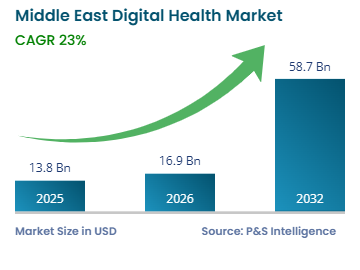
The Middle Eastern digital health market size will be an estimated USD 13.8 billion for 2025, and it will grow by 23.0% during 2026–2032, to reach USD 58.7 billion by 2032.
The significant growth drivers for the market include rapid digital transformation initiatives under national visions like Saudi Arabia’s Vision 2030 and the UAE’s National Digital Health Strategy, combined with increasing smartphone penetration and rising burden of chronic diseases across the region.
Major healthcare systems are adopting artificial intelligence and cloud-based solutions to enhance patient care delivery, with AI-powered diagnostic tools enabling faster diagnoses in UAE hospitals. The convergence of high smartphone penetration rates—exceeding 90% in countries like the U.A.E., Saudi Arabia, and Kuwait—with government-backed digital infrastructure investments is creating a robust ecosystem for digital health innovation.
Furthermore, the increasing prevalence of lifestyle-related conditions, particularly diabetes, which affects approximately 18% of the adult population in the Middle East, is accelerating demand for remote monitoring solutions and digital therapeutics. Public-private partnerships are flourishing, exemplified by collaborations between international technology vendors and regional healthcare providers, establishing the Middle East as a global benchmark for digital health transformation.
Middle East Digital Health Market Trends & Drivers
Technological Infrastructure Advancement Is Key Trend
- The robust technological infrastructure development across the Middle East serves as a fundamental digital health market trend.
- The widespread mobile connectivity, combined with expanding 5G networks and high-speed internet access, provides the essential foundation for mobile health applications and telemedicine services.
- Major technology providers are establishing regional data centers to ensure data sovereignty and reduce latency, addressing previous concerns about data security and compliance.
- The integration of IoT devices and wearable technologies is creating comprehensive digital health ecosystems that enable real-time health monitoring and predictive analytics.
- Furthermore, the region’s young, tech-savvy population is driving demand for digital-first healthcare experiences.
- With over 70% of smartphone owners in the Middle East being under 34 years old, there is strong consumer readiness for mobile health solutions, digital consultations, and AI-powered health assistants.
- This demographic advantage positions the Middle East favorably for rapid digital health adoption compared to regions with aging populations resistant to technological change.
- Public–private partnerships are facilitating the rollout of AI-ready infrastructure and regional data centers, ensuring compliance with local regulations while enhancing service delivery.
- The expansion of digital health startups and innovation hubs is fostering the development of robust technological infrastructure and localized healthcare solutions.
Government Digital Transformation Initiatives Are Biggest Driver
- The foremost driver accelerating digital health adoption across the Middle East is the comprehensive government-led digital transformation programs implemented by regional authorities.
- Saudi Arabia’s Vision 2030 healthcare objectives prioritize digital modernization, with the kingdom investing over USD 50 billion in healthcare initiatives, including nationwide electronic health record implementation and AI-powered health services.
- The Health Sector Transformation Program aims to provide inclusive health services to 88% of the Kingdom’s population and implement a unified digital medical records system for 100% of the population by 2025.
- These government initiatives extend beyond mere technology adoption, encompassing regulatory frameworks, data governance standards, and interoperability protocols that create an enabling environment for digital health innovation.
- The commitment to digital health is further evidenced by specialized programs such as Qatar’s Health Vision 2050 and Oman’s eHealth initiatives, which focus on building integrated health information exchanges and population health management platforms.
- These strategic national frameworks are not only modernizing healthcare delivery but also attracting international digital health vendors and fostering local innovation ecosystems.
Middle East Digital Health Market Segmentation Analysis
Technology Analysis
The telemedicine category holds the largest market share, of 45%, in 2025, and it will have the highest CAGR during the forecast period, due to the sustained momentum from pandemic-era adoption and continued government support for virtual care infrastructure. The integration of AI-powered triage systems, multi-lingual support capabilities, and specialized teleconsultation platforms for chronic disease management serves as a key growth catalyst. The technology’s ability to address healthcare access challenges in remote areas while reducing the burden on physical healthcare facilities makes it particularly attractive for regional health authorities pursuing universal health coverage goals.
Modern technology has empowered physicians to consult with patients through video-conferencing tools that comply with the Health Insurance Portability and Accountability Act (HIPAA). Telemedicine serves as a means to enhance the accessibility and affordability of healthcare, while also fostering greater patient engagement.
The technologies analyzed in this report are:
- Mobile Health (mHealth)
- Connected devices
- mHealth apps
- Services
- Electronic Health Record (EHR)
- Telemedicine (Largest and Fastest-Growing Category)
- Teleconsulting
- Telemonitoring
- Tele-education
- Tele-training
- Healthcare Analytics
- Descriptive
- Predictive
- Prescriptive
End User Analysis
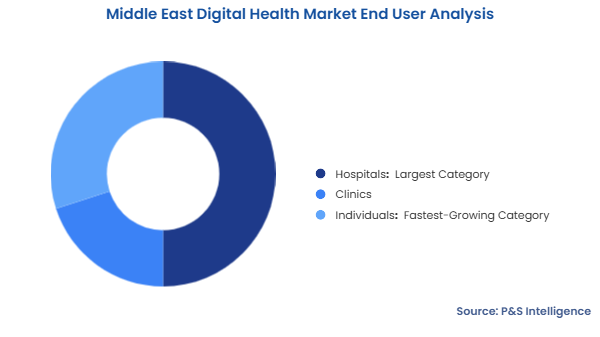
The hospitals category holds the largest market share, of 50%, in 2025, driven by large-scale digital transformation projects and substantial capital investments in healthcare infrastructure. Major hospital networks across Saudi Arabia, the U.A.E., and Qatar have implemented comprehensive digital health platforms encompassing EHR systems, clinical decision support tools, and integrated telehealth capabilities. Hospitals, with their concentration of specialized medical expertise and advanced diagnostic equipment in hospital settings, make them natural hubs for digital health innovation, particularly in areas like AI-assisted radiology and robotic surgery.
The individuals category will have the highest CAGR, of 23.2%, reflecting the consumer-driven transformation of healthcare delivery models. The rise of direct-to-consumer digital health services, including virtual primary care, mental health apps, and personalized wellness platforms, is empowering individuals to take greater control of their health journey. Factors such as increasing health awareness, preference for convenience, and the availability of affordable smartphone-based health solutions are driving this remarkable growth trajectory.
In the Middle East, digital health technologies are widely embraced. As per Koninklijke Philips N.V., around 95% of UAE residents believe tech helps manage their health efficiently. In Saudi Arabia, 48% use mobile health apps for exercise and diet. Among telehealth users, over 90% report high satisfaction, citing convenience, usefulness, and overall effectiveness of remote care.
The end users analyzed in this report are:
- Hospitals (Largest Category)
- Clinics
- Individuals (Fastest-Growing Category)
Drive strategic growth with comprehensive market analysis
Middle East Digital Health Market Regional Outlook
Saudi Arabia Market Size
Saudi Arabia holds the largest market share, of 35%, in 2025. This dominance is primarily attributed to the Kingdom’s ambitious Vision 2030 healthcare transformation agenda, which has catalyzed unprecedented investments in digital health infrastructure. The Saudi government allocated over USD 50 billion toward healthcare digitalization initiatives, including the implementation of the world’s largest health information exchange through a partnership with Orion Health, connecting 5,000 government and private health institutions serving 32 million people.
The kingdom’s digital health ecosystem is rapidly maturing, with flagship initiatives like Seha Virtual Hospital providing comprehensive telehealth services and the Sehhaty app, which serves millions of users for appointment scheduling and health record access. The expansion of AI-powered diagnostic solutions, exemplified by King Faisal Specialist Hospital’s implementation of AI-based imaging for early tumor detection, demonstrates the country’s commitment to leveraging cutting-edge technologies for improved health outcomes.
U.A.E. Market Size
U.A.E. will have the highest CAGR, of 23.1%, positioning it as the region’s innovation hub for digital health technologies. Dubai’s achievement of 100% EMR adoption across all hospitals and 75% adoption in private clinics by 2023 exemplifies the emirate’s digital-first approach to healthcare transformation. The establishment of dedicated innovation labs, such as Acorn Research’s AI-driven Healthcare Innovation Lab at Arab Health 2025, reinforces the U.A.E.’s commitment to pioneering advanced digital health solutions.
The country’s strategic location, business-friendly environment, and world-class infrastructure have attracted major international digital health vendors to establish regional headquarters and R&D centers. According to government statistics, over 90% of the U.A.E. population has smartphone penetration, creating ideal conditions for mobile health adoption. The U.A.E.’s forward-thinking approach to healthcare digitalization is demonstrated through the integration of AI-focused government initiatives and partnerships with global technology leaders, such as Care AI, to implement smart hospital solutions.
Qatar Market Size
Qatar’s digital health market is experiencing robust growth driven by its National Health Strategy and preparations for hosting major international events. The country’s investment in state-of-the-art healthcare facilities equipped with advanced digital technologies has positioned it as a regional leader in healthcare innovation. The implementation of comprehensive health information exchanges and population health management platforms has enabled Qatar to achieve significant improvements in care coordination and clinical outcomes. The country’s focus on research and development, supported by institutions like Qatar Foundation, is driving indigenous innovation in areas such as precision medicine and AI-powered diagnostics.
The geographical breakdown of the market is as follows:
- Saudi Arabia (Largest Country Market)
- U.A.E. (Fastest-Growing Country Market)
- Qatar
- Kuwait
- Oman
- Bahrain
- Rest of the Middle East
Middle East Digital Health Market Share
The market is fragmented, as it hosts a wide range of global companies, regional firms, and local startups operating across diverse segments such as telemedicine, mHealth, EHR, and analytics. Competition is intense, with no single vendor holding a dominant market share across the region. This fragmentation is particularly evident in telehealth and mobile health solutions, where numerous players offer overlapping services, leading to a highly competitive environment and limited concentration of power among individual companies.
Key Middle East Digital Health Companies:
- Altibbi Ltd.
- Vezeeta.com
- Meddy Health Co.
- HealthHub by Al-Futtaim
- Aster DM Healthcare Limited
- Group 42 Holding Ltd
- M42 Global Health
- Oracle Health
- Siemens Healthineers AG
- Philips Healthcare
- GE HealthCare Technologies, Inc.
- Babylon Health Technologies Ltd.
Middle East Digital Health Market News
- In May 2025, MedIQ successfully raised USD 6 million in Series A funding to accelerate the expansion of its AI-driven digital healthcare solutions across Saudi Arabia, Qatar, and other Gulf states, offering comprehensive EHR, revenue cycle management, telehealth, and AI decision support systems aligned with regional Vision 2030 objectives.
- In July 2025, HIMSS partnered with WHX Tech to accelerate digital health transformation across the Middle East, delivering professional development programs, insights, and global best practices through the WHX Tech event in Dubai, with backing from regional health authorities.
- In June 2025, Healthtrip launched Healinharam.com, a digital platform designed to connect international pilgrims with trusted medical, wellness, and chronic care services in the holy cities of Makkah, Madinah, and Jeddah.
- In October 2024, the World Health Organization partnered with Saudi Arabia to launch the Hajj Health Card Initiative, a secure digital health tool built on the WHO Global Digital Health Certification Network, highlighting the region’s leadership in developing interoperable health solutions.
link