
LCMC Health is committed to reducing cancer rates throughout Louisiana. In recent months, the system has placed an emphasis on lung cancer, with strategic and visionary initiatives and recruitments to diagnose the disease earlier and ensure that all patients have access to the most comprehensive and cutting-edge care available.
Lung cancer is responsible for 27 percent of cancer deaths in Louisiana, making it the leading cause of cancer deaths in the state, claiming more than 2,300 lives each year. Yet, a surgical cure is possible when lung cancer is found early.
“The most common symptom of lung cancer is a cough. We know that a cough can be caused by anything – pollen, allergies, pets,” said Dr. Leonard Wudel Jr., chief of the division of thoracic surgery for the LSU-LCMC Health Cancer Center. “That’s why we tell people that if your cough lasts more than three or four weeks, you need to get it checked out.”
Dr. Wudel joined the LSU-LCMC Health Cancer Center in September from the world-renowned Cleveland Clinic. His arrival comes as the LSU-LCMC Health Cancer Center pursues an NCI Designation. Achieving this prestigious designation will have a tremendous impact on our region but requires that we effectively tackle high impact cancer challenges, such as lung cancer. His expertise, along with that of other LCMC Health clinicians, ensures that when lung cancer is identified early, patients can receive the most advanced surgical treatments available.
In addition to surgery, LCMC Health offers lung cancer patients targeted therapy and immunotherapy treatments that are among the most cutting-edge in the region. These advanced methods complement LCMC Health’s active clinical trials program.
“We have medications that can target specific cancer cells and leave everything else alone. We also have immunotherapy, in which medications reprogram the body’s own defense systems to recognize and kill cancer cells,” Dr. Wudel said. “Patients who were not a candidate for an operation five years ago can now be treated with these methods. We can intervene and hopefully have much better outcomes.”
This work will become more effective with an increased number of annual lung cancer screenings. Dr. Wudel said these screenings are especially important because symptoms often do not arise until the cancer is more advanced and thus more difficult to treat. Current guidelines recommend screenings for people ages 50 to 80 who have smoked or quit smoking within the past 15 years and who have at least a 20 pack-year history of smoking. At LCMC Health, the screenings take place using a low-radiation CAT scan, and the results are available within two to three days.
Dr. Wudel said he believes LCMC Health can continue to be at the forefront of new innovations in lung cancer treatments. Today, researchers are working to improve targeted therapies with more precise genetic evaluations, while technology companies are using quantum computing and artificial intelligence to track cells in real time and create faster diagnosis options.
“There’s been so much progress in a relatively short amount of time, and that’s exciting for me as a physician,” Dr. Wudel said. “When I see the new research being done, the technology coming forward is remarkable, and I think there are amazing things about to happen in the future.”
That spirit of innovation is already apparent at LCMC Health, where physicians are putting the latest lung cancer advancements into practice – bridging research and real-world care to improve patient outcomes.

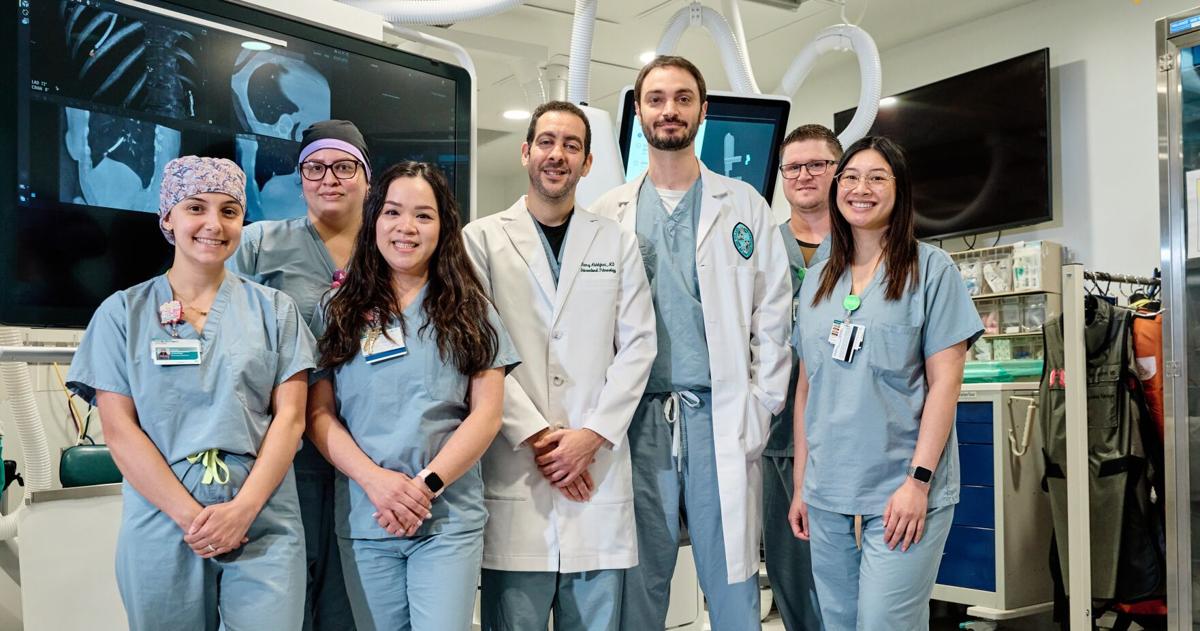
Earlier this year, LCMC Health clinicians at East Jefferson General Hospital (EJGH) partnered with experts from Tulane to reach a historic milestone by successfully performing the first minimally-invasive, combined interventional pulmonology and thoracic surgery procedure in the LCMC Health system. The achievement was made possible through a collaboration between interventional pulmonologist, Dr. Ramsy Abdelghani, and thoracic surgeon Dr. Wassim Abi Jaoude at EJGH.
When doctors discovered the patient had a five-millimeter pulmonary nodule, Dr. Abdelghani and his team used the Ion robotic bronchoscope to biopsy the nodule, confirming lung cancer. Dr. Abdelghani and his team then localized and marked the nodule using a specialized dye technique. Immediately afterward, while the patient was still asleep, Dr. Abi Jaoude and his team used the Da Vinci robotic surgical platform to precisely remove the affected portion of lung tissue, preserving healthy lung function and minimizing recovery time.
“This type of combined, same-day procedure represents a major advancement in lung cancer care – a minimally-invasive combined procedure that maximizes precision and significantly improves patient outcomes,” Dr. Abdelghani said. “This sets the stage for more collaborative, multidisciplinary care pathways that bring the most cutting-edge technology and care to our patients.”
Dr. Abdelghani said the landmark procedure is an ideal example of how coordinated care can make a world of difference for patients.
“There’s always room for collaboration between interventional pulmonology and thoracic surgery, particularly as it relates to decreasing the time between cancer detection and removal,” Dr. Abdelghani said. “If you can diagnose and intervene on a patient who has Stage One lung cancer, the survival rate is as high as 95 percent. If the cancer is not diagnosed until Stage Four, the survival rate is much lower. The patient’s prognosis is much improved when you can address the cancer earlier, and they also have less anxiety because they aren’t waiting so long for the next step.”
The patient in the groundbreaking case has since recovered, is cancer-free and remains under routine surveillance. Dr. Abdelghani said the success has given LCMC Health surgeons hope that the procedure can be replicated across the entire system.
“This is a testament to the care that LCMC Health is providing for our patients and the fact that we can give them increased access to advanced procedures,” he said. “We’ve proven that we can do state-of-the-art procedures at a high level. We want to be a destination for lung cancer care throughout this region.”
link